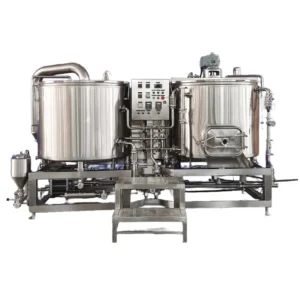
Brewers often underestimate water in beer recipes. Yet the mineral composition, residual alkalinity, and sulfate-to-chloride ratio of brewing water directly affect flavor, aroma, mouthfeel, mash efficiency, and fermentation performance. From light lagers to IPAs, different beer styles demand very different water profiles.
For craft breweries, water consistency matters even more than the water source itself. MadTree Brewing in Ohio has used reverse osmosis for all process water since its founding in 2013—ensuring consistent mineral composition and precise brewing water profiles across every beer, from Cologne-style to French Saison.
Common Water Challenges in Breweries
Most breweries rely on municipal water or groundwater, which often presents the following issues:
Chlorine and chloramine in municipal water: Even trace residues can produce off-flavors during brewing and inhibit yeast activity. Activated carbon filtration effectively removes chlorine and organic matter, ensuring clean-tasting, odor-free water.
High groundwater hardness: Excessive calcium and magnesium affect mash pH, which in turn impacts fermentation efficiency and final flavor. Well water often contains iron and manganese—impurities that not only affect brewing water quality but can also cause equipment scaling and biofilm formation.
Microbial risk: Microorganisms can breed in water treatment networks, especially inside filters. UV disinfection, as a chemical-free method, effectively inactivates microorganisms in water.
Inconsistent ion composition: Breweries need a "blank canvas" water source that can be adjusted with specific minerals for different beer styles. Reverse osmosis membranes are the core technology that makes this possible.
Single-Stage RO Equipment: A Practical Choice for Breweries
For small to mid-sized craft breweries, pilot brewhouses, or newly launched production lines, 1T/H single-stage RO equipment for brewery water treatment offers a solution that balances performance and cost.
Key Specifications
- Output: 1 ton/hour, meeting pure water needs for small-to-medium brewing, cleaning, and filling
- Desalination rate: Single-stage RO systems achieve over 98%
- Product water quality: Conductivity typically below 10μs/cm (with feed water <500μs/cm)
Technical Features
The equipment uses physical desalination. At room temperature, pressure drives water molecules through the RO membrane while rejecting ions, organics, bacteria, and viruses. This process does not rely on large amounts of chemicals or acid-base regeneration, and produces no chemical waste discharge.
For breweries needing stable daily output, the system runs continuously with a simple structure, easy operation, and consistent product water quality.
Complete Pretreatment Process for Single-Stage RO Equipment
A single-stage RO main unit requires a pretreatment system to protect the RO membrane and ensure product water quality. A typical process includes:
Raw water → Quartz sand filter → Activated carbon filter → Scale inhibitor dosing → Ultrafiltration → High-pressure pump → Single-stage RO main unit → Pure water
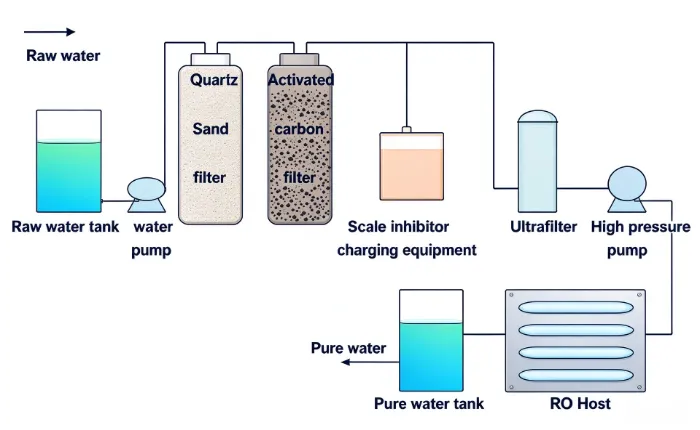
Quartz sand filtration removes suspended solids and particulate matter. Activated carbon filtration adsorbs residual chlorine and organics, protecting the RO membrane from oxidative damage. Scale inhibitor dosing prevents membrane scaling. Ultrafiltration serves as precision pretreatment, further intercepting fine particles.
For breweries looking to build a complete water treatment line, pairing the RO unit with a reliable ultrafiltration unit and proper pretreatment equipment ensures long-term membrane performance and stable output.
Multi-Scenario Applications of Brewery Water Treatment
Brewing water preparation: RO water serves as "base water" that can be customized with specific minerals for different beer styles. MadTree Brewing uses RO technology to ensure completely consistent mineral composition across every beer.
CIP cleaning and rinse water: RO water introduces no additional ions during cleaning, helping maintain equipment cleanliness and product purity.
Boiler feed water: RO water reduces boiler scaling risk, extends equipment life, and lowers energy consumption.
Filling line water: Ensures no microbial or impurity contamination during the filling process.
What Should Breweries Look For?
Assess your water source first: Different sources (municipal, well, surface water) require significantly different pretreatment configurations. A complete water analysis before selecting a system is essential.
Match output to demand: 1T/H suits small craft breweries producing hundreds of liters to several tons per day. If growth is planned, reserve capacity for future expansion.
Automation level: Fully automatic operation reduces manual intervention. Automatic flushing helps maintain stable membrane performance.
Material selection: For food and beverage applications, 304 stainless steel wetted parts are recommended to avoid secondary contamination.
Frequently Asked Questions
What water quality do breweries need?
Breweries need water with consistent mineral composition, low residual alkalinity, and no chlorine, chloramine, or microbial contamination. The ideal brewing water acts as a "blank canvas" that can be adjusted for different beer styles.
How does reverse osmosis improve brewing water?
RO removes over 98% of dissolved ions, salts, heavy metals, bacteria, and organics. This gives brewers full control over mineral profiles, enabling precise adjustments for lagers, IPAs, stouts, and other styles.
What size RO system does a small brewery need?
A 1T/H single-stage RO system suits most small craft breweries, like 1000L microbrewery. If your daily production exceeds several tons, consider a larger system or parallel configuration.
Can RO water be used for all beer styles?
Yes. RO water serves as base water. Brewers then add specific minerals—such as calcium sulfate or calcium chloride—to match the target profile for each style, from crisp pilsners to hoppy IPAs.
The quality of your brewing water ultimately shows up in every glass of beer. For craft breweries, 1T/H single-stage RO equipment offers an economically viable path to control water quality at the source and build a foundation for product consistency.
If you're planning a brewery water treatment solution for your brewery, explore our brewery water treatment equipment or contact us for tailored advice based on your water source conditions.