Pure draft beer is beer that never receives heat pasteurization. Mature low-temperature beer goes through strict non-thermal sterile treatment and aseptic filling. Because brewers skip the traditional pasteurizer, the beer keeps a fresh hop aroma, clean mouthfeel, rich foam, strong CO₂ and high drinkability. Nutrients survive intact. The trade-off is demanding hygiene: no pasteurizer means lower utility cost and less floor space, but the brewery must build a true sterile environment from filtration to capping.
Three Sterilization Routes (Why Cold Filtration Wins)
- Chemical inhibition: add benzoate, sorbate, natamycin or nisin to suppress microbes. Simple but it alters label chemistry.
- UV treatment: weak penetration, may hurt flavor — rarely used today.
- Cold sterile filtration: the industry standard. Beer passes diatomaceous earth filter → sheet polish filter → 0.45 μm membrane system. This removes yeast and vegetative bacteria without heat, protecting hop volatiles and foam proteins.
Core Process of Pure Draft Beer
1. Fermentation & Maturation
Use a conical fermenter one-vessel process. Ferment cold, hold at 0℃ for 20 days, reach apparent attenuation above 80%. The ferment room stays under positive sterile pressure; sampling happens aseptically. A glycol chiller and insulated bright tank keep the beer near 0℃ before filtration.
2. Filtration Train (The Heart of Pure Draft)
- Diatomaceous earth filter – removes bulk yeast and solids.
- Sheet / lenticular depth filter – polishes colloids and haze.
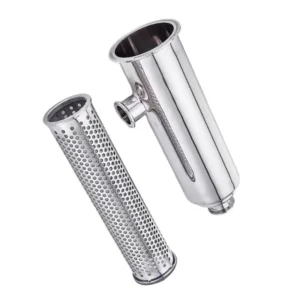
- 0.45 μm membrane filter – final absolute barrier. Housing is 316L stainless; the system includes integrity testing (bubble point / forward flow) before and after each run.
Alternative ceramic system (Sapporo / Steinmetz style): conical housing with ceramic candles, wall 15–25 mm, 30–40% uniform pores, pre-coated with cellulose + DE, retains ≥0.45 μm solids, regenerated by 0.45 MPa sterile air pushing sterile water backflush.
Membrane cleaning cycle: soak 2% NaOH 2 h → rinse neutral → 0.6% HNO₃ 2 h → rinse neutral → 0.1 MPa steam 20 min. Pipework sanitized with 85℃ hot water 30 min.
3. Aseptic Filling Requirements
- Empty cans: washer + ≥80℃ hot water spray.
- Empty bottles: high-pressure sterile water rinse → 105℃ saturated steam 2–3 s or 145℃ steam 0.8 s.
- Caps: steam, alcohol bath or UV.
- Filling room: sterile room, positive pressure 0.03–0.05 kPa, fresh-air HVAC, divided into bays to stop cross-contamination.
- Filler and piping: CIP system with caustic/acid/steam; exterior manual scrub or high-pressure wash.
- Conveyor: sterile lubricant, UV tunnel from washer to filler.
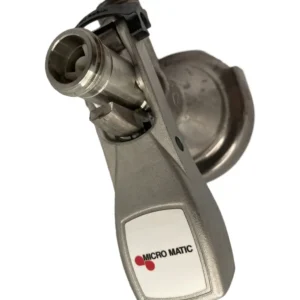
Kegged pure draft: 3–4 stage filtration → sealed into stainless kegs → served through keg dispenser with inline CO₂ top-up and cooling; shelf life 20–30 days at 0–8℃.
Equipment List a Pure-Draft Line Needs
- Conical jacketed fermenters + glycol chiller
- Bright / clear beer tanks (0–2℃ buffer)
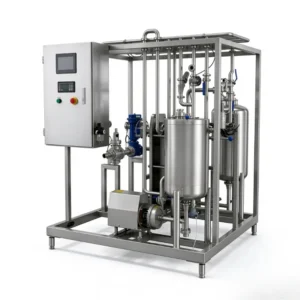
- DE filter + sheet filter + 0.45 μm membrane skid (with integrity tester)
- CIP set (caustic / acid / sterile water)
- Aseptic filler in clean room + cap sterilizer
- Bottle washer / can washer + UV tunnel
- CO₂ back-pressure system, sterile air filter, steam generator
Pure draft is not “a filter you buy” — it is a contamination-controlled chain. The membrane is the last gate; the fermenter, pipes, tank vents and filler decide whether it works.
Looking for a complete pure draft beer line — fermenters, membrane filtration skid and aseptic filler? Contact us for layout and quote.