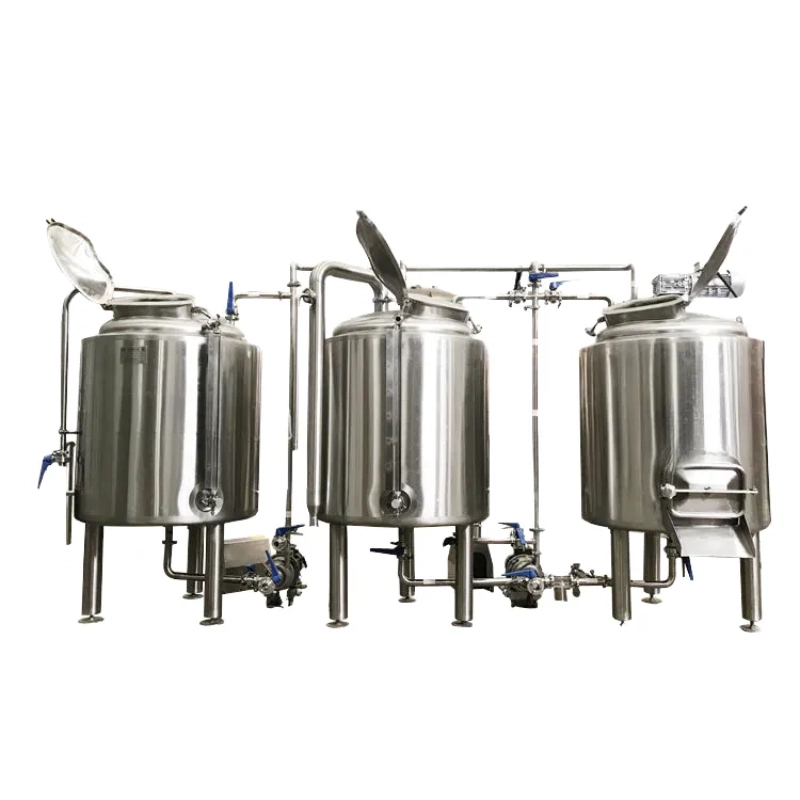
Before fermentation tank is put into normal production, it needs to be cleaned and sanitized properly. A clean tank is essential for beer quality, fermentation stability, and avoiding contamination.
The following cleaning procedure is commonly used for stainless steel fermenter tanks. It includes four main stages: water rinsing, lye cleaning, water rinsing again, and hydrogen peroxide sanitation.
Step 1 – Initial Water Rinsing of the Fermentation Tank
Start by connecting a hose from the tap water outlet to the CIP port of the fermenter tank.
Then connect another hose from the discharge port at the bottom of the tank to a drainage channel.
Open the tap water valve, the CIP valve, the simple valve, and the discharge valve. Let water flow through the tank until the water coming out of the drainage outlet runs clear. Repeat this rinsing process three times.
Important note:
The cleaning pressure should be at least 1.0 bar. If your water pressure cannot reach this level, you can add water to the brewhouse system and use the brewhouse pump to push water through the tank instead.
Step 2 – Lye Cleaning for the Fermentation Tank
Prepare a 3% alkali (lye) solution in the kettle or whirlpool tank. Heat the solution until it reaches 50°C, then stop heating.
Transfer the lye solution into the conical fermenter through the wort pump. Connect the wort pump inlet to the discharge port at the bottom of the fermenter with a hose, and connect the wort pump outlet to the CIP cleaning port of the fermenter with another hose.
Open the relevant valves and start the wort pump. Let the solution circulate through the tank for about 20 minutes.
During circulation, briefly open the beer outlet for 1–3 seconds, then close it. Repeat this three times.
When cleaning is finished, pump the lye solution into another fermenter for reuse, or discharge it properly.
Step 3 – Second Water Rinsing
Repeat the same procedure as in Step 1.
Before rinsing, open the beer outlet. Once there is no negative pressure inside the tank, close the beer outlet again.
Step 4 – Hydrogen Peroxide Sanitation
Prepare a 0.5% hydrogen peroxide solution in the kettle, whirlpool tank, or fermenter.
Use the same circulation procedure as in Step 2 to sanitize the fermenter tank.
After sanitation is complete, close all valves.
Important Safety and Operational Precautions
A. Never enter a fermenter tank immediately after use.
The carbon dioxide concentration inside can be dangerously high and may cause suffocation. If entry is absolutely necessary, first use air to displace the CO₂ inside the tank. Make sure all valves and manholes are open, and always have someone standing by outside. Never enter a fermenter tank alone or without authorization.
B. Always wear protective equipment.
Lye and hydrogen peroxide are corrosive. Avoid direct contact with skin and eyes.
C. Keep the sampling port open during cleaning.
Close it only after cleaning is fully completed.
D. After lye cleaning and before water rinsing,
open the beer outlet first. Once there is no negative pressure, close the beer outlet valve before continuing the rinse.
E. Do not use hot water, hypochlorous acid, chlorine gas, or other chlorine-containing sanitizers to sterilize fermenter tanks. These can damage the stainless steel surface.
F. Avoid immediate low-temperature rinsing after hot cleaning.
If you rinse a hot conical fermenter with cold water (below 10°C) right away, negative pressure can form inside and deform the tank. Let the tank cool down to normal temperature (below 30°C) before rinsing with cold water.
Cleaning a fermenter tank properly before use is not just about hygiene. It also protects your equipment, improves fermentation consistency, and helps you produce better beer.
Following a clear four-step cleaning routine—water rinse, lye cleaning, water rinse, and hydrogen peroxide sanitation—will keep your fermenter in good condition and reduce the risk of contamination.
Always follow safety guidelines, especially when working with lye, hydrogen peroxide, and carbon dioxide. A clean and safe brewery is a productive brewery.