If you're a rewer, you're probably not just the person in charge of what's inside the fermentation tanks. From selecting equipment and negotiating with suppliers to overseeing installation and confirming on delivery day that everything actually runs, procurement is often a job the breer carries.
And the most underrated — and most likely to blow up at the last minute — part of procurement is electricity. Not "which utility company to use," but a much earlier question: what voltage, what frequency, single-phase or three-phase should this equipment be customized to? Grid parameters vary around the world, and from the moment you place the order, the equipment has to match the grid at your brewery. Get the customization right and it's plug-and-play. Get it wrong and even great equipment goes back for rework.
First, understand: single-phase vs. three-phase is not just "how many wires"
The most obvious difference between single-phase and three-phase is what they're used for. Single-phase is typically for lighting, outlets, and small appliances; three-phase is for industrial power loads — pumps, compressors, mixer motors. In China, single-phase is 220V and three-phase is 380V, but that's the Chinese standard, not a global one.
The difference that actually matters to a brewery is whether the motor can start and run smoothly. A single-phase supply produces a pulsating magnetic field — the motor has no starting torque and needs a capacitor or start switch to get going. Three-phase has three phases offset by 120 degrees, producing a rotating magnetic field, so the motor has clear starting torque the moment power is applied. That's why nearly every core piece of equipment in a brewery that needs to "spin" — mash agitators, wort pumps, refrigeration compressors — is three-phase designed once power goes up at all. Single-phase is generally only suitable for smaller loads.
Three-phase has another often-overlooked advantage: constant power output. Single-phase instantaneous power drops to zero twice per second, while three-phase total power stays constant. For a continuously running refrigeration compressor, steady power input means less vibration, less heat, and a longer service life.
Voltages around the world: there is no such thing as "global standard"
If you only brew in one country, remembering the local standard is enough. But as a brewer who procures equipment, you need to know how fragmented this map is — because when a supplier quotes parameters, the "standard" they default to is often their own country's.
North American system: In the US, Canada, and elsewhere, residential voltage is 110–120V at 60Hz; commercial and industrial settings commonly use 208V, 240V, and 480V three-phase.
Europe and most of Asia and Africa: around 230V single-phase, around 400V three-phase, 50Hz — the most common combination globally. The UK nominally uses 230V (historically 240V), and Germany, France, Italy, Australia, and China all broadly fall within this system, with slight numerical differences.
Japan: one of the most unusual markets. Voltage is 100V, and East Japan is 50Hz while West Japan is 60Hz, divided roughly around Mount Fuji. The same piece of equipment shipped to Tokyo and to Osaka needs different frequency parameters.
South Korea: 220V but at 60Hz — an outlier in Asia.
Brazil: 127V and 220V coexist at 60Hz, with some regions carrying historical inconsistencies. Even within one country, it's not fully unified.
India: nominally 230V 50Hz, but actual grid fluctuation is wide, so voltage tolerance requirements need generous margin when customizing.
When procuring equipment, what does voltage customization actually mean?
First, voltage level. Is your equipment designed for 230V single-phase or 400V three-phase? 208V or 480V? This number must match the grid at your brewery — no "close enough." A unit designed for 380V connected to a 480V grid isn't a derating issue; it's a damage issue.
Second, frequency. The 50Hz vs. 60Hz difference has little effect on resistive loads (heating elements, electric tubes) but a direct effect on motor loads. A motor designed for 60Hz on a 50Hz grid runs about 17% slower, and pump flow and compressor output drop accordingly; conversely, a 50Hz motor on a 60Hz grid spins faster with changed current and may overheat in long-term operation. Confirm frequency at order time — it matters as much as voltage.
Third, phase count. The same equipment may need both single-phase and three-phase versions for different markets. The core loads in a brewery — refrigeration, pumps, agitation — depend on three-phase not as a "preference" but as a physical matching requirement. Before ordering, confirm whether your site has three-phase supply and what the three-phase voltage is.
Fourth, plugs and wiring. This is the most tedious item and the one most likely to fail at the last mile. Plug shapes, grounding methods, and wire color codes all differ by country. Write these details into the specification confirmation sheet at procurement time — far more reliable than hunting for adapters after delivery.
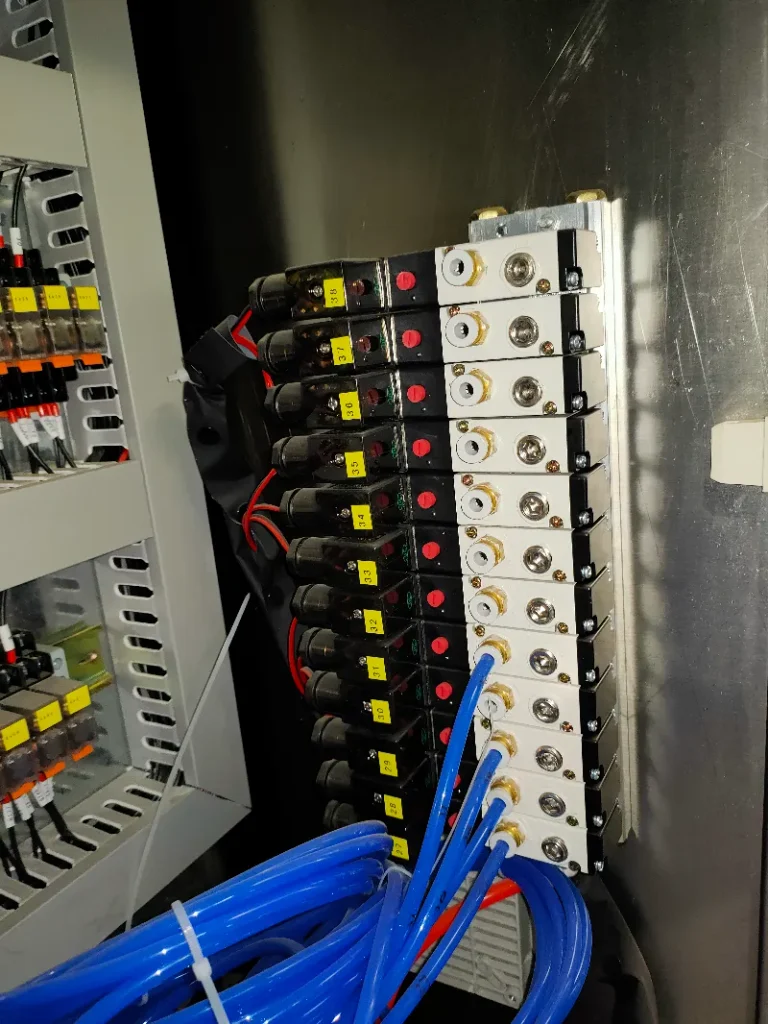
A simple procurement framework for brewery electricity options
Define your grid first, then the equipment parameters. Align voltage, frequency, and phase count in one pass and write them into the procurement spec. Don't order to the supplier's "default standard" and hope to adapt on site.
Confirm frequency first for motor loads. Pumps, compressors, and mixer motors are frequency-sensitive — make frequency a hard requirement at procurement. Resistive loads can be looser, but there's no reason to leave a hidden risk for convenience.
Verify three-phase supply conditions in advance. Whether your site offers three-phase power and at what voltage is a shared prerequisite for equipment procurement and site preparation. A site with only single-phase supply severely limits core equipment selection.
Wide-range design is a bonus, not a default. Some equipment supports 200–240V / 50–60Hz wide-range input, which is far more flexible. But wide range isn't full range — confirm the actual input range before ordering rather than assuming it "should work."
Confirm plug and wiring details too. Tedious, but not skippable.
Brewing is the art of control. You control the crush, the mash temperature curve, every degree of fermentation. Voltage, frequency, and phase count are ultimately the same thing: get the parameters right before the order is placed. That's the one thing a brewer can — and should — do at the procurement table. The rest is left to a good glass of beer to prove.